We independently review and recommend products. If you buy through links on this page, we may earn a commission.
How to Store Pots and Pans in a Small Kitchen (9 Real Solutions)
If you’ve ever opened a cabinet and had a pan lid crash to the floor, you already know the problem. Pots and pans are bulky, oddly shaped, and never seem to stack the way you want them to. In a small kitchen, that chaos multiplies fast, and it usually ends with a cabinet you’re almost afraid to open.
The good news: you don’t need a bigger kitchen to fix this.
You need a better system, and a few of the right pieces. Here’s exactly how to do it, starting with the one step almost everyone skips.
Step One: Do You Actually Need All of These?
Before buying a single organizer, take everything out of your cookware cabinet and be honest with yourself. Most people only regularly use:
- One frying pan
- One saucepan
- One larger pot
Everything else, the pan you got as a gift and never used, the three lids that don’t match anything, is just taking up space you don’t have. Donate or sell what you haven’t touched in the last six months.
This single step solves more of your storage problem than any organizer will, and it costs nothing.
It’s also worth thinking about whether you’re renting or own your place, since that changes which of the solutions below make sense for you. Renters generally want options that don’t require drilling into walls or cabinets, while homeowners have more freedom to install permanent fixtures. We’ve noted which is which as we go.
1. Stand Pans Up with a Cabinet Divider
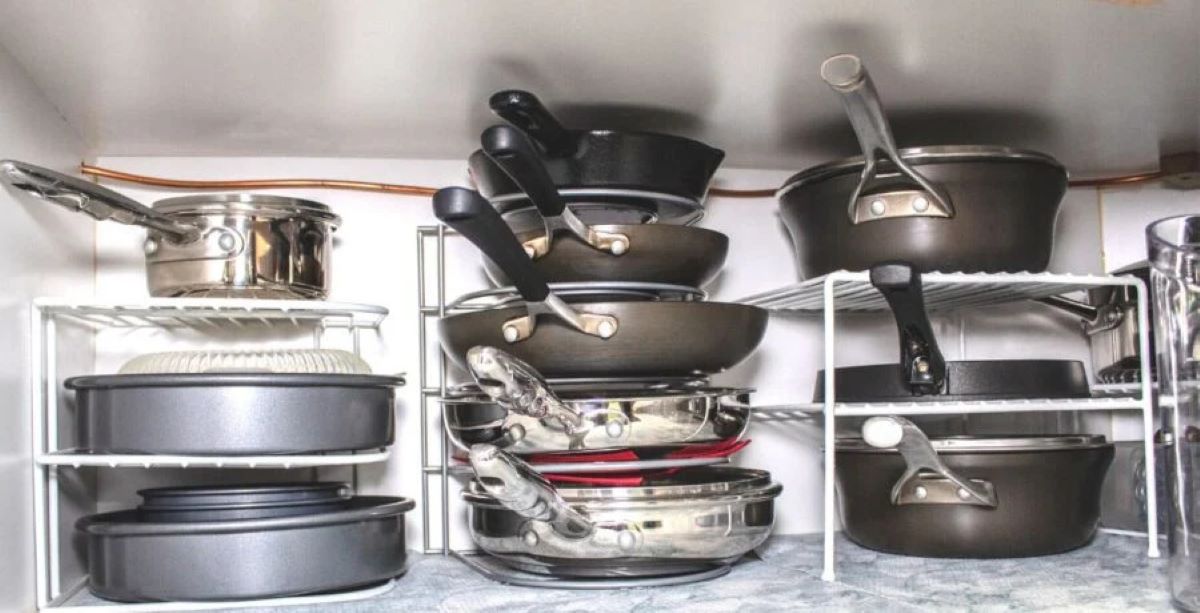
Stacking pans flat means digging through all of them to get the one on the bottom, and it’s how handles get scratched. A simple wire or bamboo divider turns your cabinet into vertical “file folders” for your pans. You can grab the one you want without moving the rest.
Renter-friendly: yes, no installation needed.
What to get: a set of adjustable cabinet dividers, usually sold in packs of 4 to 6, typically $15 to $25. Look for ones with rubber grips so they don’t scratch your cookware, and measure your cabinet depth before buying, since most dividers are adjustable but have a minimum width.
2. Get Pots Off the Cabinet Floor Entirely
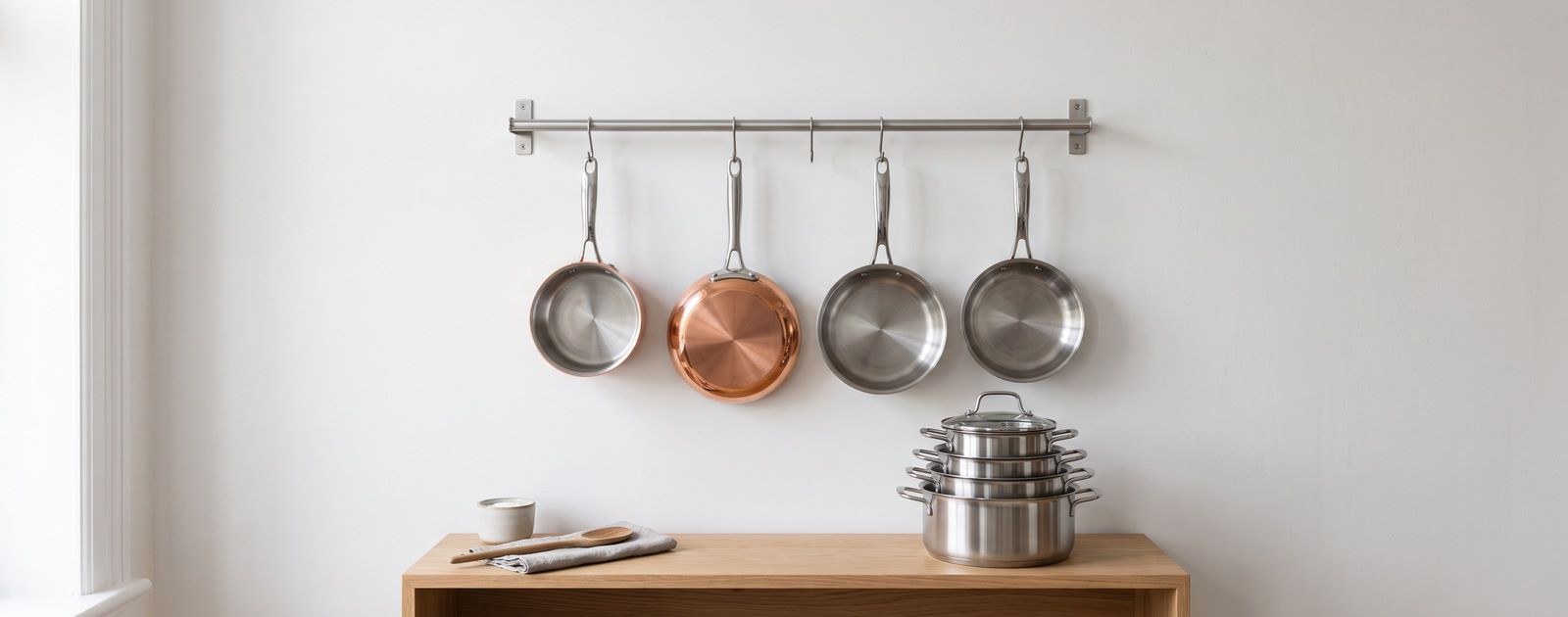
If cabinet space is truly the bottleneck, take pots out of the equation completely with a wall mounted rail or a small hanging pot rack. This works especially well in small kitchens because it uses wall space you’re not doing anything else with.
Renter-friendly: only if you can use adhesive-mounted rails rather than drilled ones. Check your lease first.
What to get: a wall rail with S-hooks is the cheapest option, often under $20, and takes about 10 minutes to install with basic tools. If you have the ceiling clearance, a hanging pot rack over an island or stove looks great and keeps your most-used pans within arm’s reach. Just make sure whatever you’re mounting into can support the combined weight of your cookware.
3. Stop Fighting with Lids
Lids are the real troublemakers. They’re a different shape than everything else, and they never stack neatly with the pots they belong to. Separate them entirely rather than trying to force them to nest with their matching pot.
Renter-friendly: yes.
What to get: a simple lid organizer rack (the kind designed for filing cutting boards and baking sheets works just as well for lids) tucked into a cabinet or a slim gap next to the fridge. A tension rod mounted inside a cabinet door is an even cheaper DIY option. The lids just slot in vertically.
4. Double Your Shelf Space with Risers
A tall cabinet shelf usually has a lot of wasted air space above your pots. A shelf riser splits that one shelf into two usable layers, small pans underneath, larger ones on top, without any tools or installation.
Renter-friendly: yes.
What to get: an expandable wire shelf riser. These need no tools to install and adjust to fit almost any cabinet width, usually for $10 to $20 a pair.
5. Use Cabinet Doors as Free Storage
The inside of a cabinet door is space most people never use. Small over-the-door racks can hold lids, cutting boards, or your smaller pans, freeing up the shelves behind them for bigger items.
Renter-friendly: yes, most of these hook over the door with no drilling.
What to get: an over-the-door pan or lid organizer rated for the weight of what you’re hanging. Check the label, since cheaper ones aren’t built for heavier cast iron lids.
6. Try a Pull-Out Basket for Corner Cabinets
Corner cabinets are notoriously wasted space, hard to reach and easy to lose things in. A two-tier pull-out basket mounted inside the cabinet makes that dead zone genuinely usable again, and it’s one of the few fixes on this list worth the slightly higher cost.
Renter-friendly: usually not, since it involves mounting hardware inside the cabinet.
What to get: a pull-out basket organizer sized to your specific cabinet. Measure carefully, since these mount to the cabinet floor and sides.
7. Add a Rolling Cart for Overflow
If you’re simply out of built-in storage, a small rolling kitchen cart adds both extra workspace and a place to stash pots and pans underneath. The advantage over a fixed shelf is that you can roll it out of the way, into a pantry, closet, or corner, when you’re not using it.
Renter-friendly: yes, it’s freestanding furniture, not a fixture.
What to get: a butcher block top rolling cart with an open shelf underneath. Store your heaviest pots on the bottom shelf for stability.
8. Use Wall-Mounted Pegboard for Total Flexibility
A pegboard mounted on an open wall gives you completely customizable, moveable storage. Hooks for pans, small shelves for pots, and the ability to rearrange everything as your collection changes. It’s a favorite of small-kitchen designers precisely because it adapts as your needs do.
Renter-friendly: check your lease. Some landlords are fine with a few small wall anchors; others aren’t.
What to get: a standard pegboard panel plus a hook variety pack. This is a slightly bigger project, since you’ll need to mount the board itself, but it’s one of the most flexible options here.
9. Switch to a Nesting Cookware Set (The Real Fix)
Here’s the truth: if your pots and pans don’t stack neatly, no organizer fully solves the problem. The most effective fix is switching to cookware that’s actually designed to nest, where your frying pan, saucepan, and stockpot fit inside each other like Russian dolls, taking up the footprint of a single pot.
This is especially worth considering if you’re cooking for one or two people and don’t need a huge collection in the first place. See our full guide to the best cookware for cooking solo for specific picks.
Common Mistakes to Avoid
Even with the right organizers, a few habits can undo your progress fast:
- Buying an Organizer Before Measuring. Cabinet dividers, pull-out baskets, and shelf risers all come in different sizes. Measure your actual space first, or you’ll end up returning things.
- Keeping Cookware “Just In Case.” If you haven’t used a pan in six months, it’s not saving you time later. It’s just taking up space now.
- Mixing Storage Systems Randomly. Pick two or three of the solutions above rather than trying all nine at once. A cabinet with a divider, a riser, and a hanging rack all competing for the same shelf gets messy fast.
- Ignoring Weight Limits. Hanging racks and over-the-door organizers are rated for a reason. Overloading them is how they end up on the floor, along with your cookware.
Related Guides
- Best Stackable Bakeware for Small Kitchens
- Vertical Storage Ideas for Tiny Kitchens
- How to Organize a One-Cabinet Kitchen?
- Small Kitchen Tools That Do Double Duty
The Bottom Line
you don’t need more space. You need fewer, smarter pieces, and a system that puts everything within reach. Start with the declutter step, add two or three of the fixes above, and your cabinet chaos should be under control within a weekend.
Frequently Asked Questions
Do I need to buy new cookware to fix a cluttered cabinet?
No. Most people can solve 80% of the problem with dividers, a shelf riser, and separating their lids, all inexpensive, no-installation fixes. A nesting set is the most effective single fix, but it's an upgrade, not a requirement.
What's the cheapest way to store pots and pans in a small kitchen?
Cabinet dividers and shelf risers are the lowest-cost options, typically under $25 total, and need no tools or installation.
Should I hang my pots and pans or keep them in cabinets?
It depends on your kitchen. Hanging storage (a wall rail or pot rack) works best if you're completely out of cabinet space or want your most-used pans within easy reach. If your cabinets just feel disorganized rather than genuinely full, dividers and risers are usually enough.
How do I stop pan lids from taking over my cabinet?
Store lids completely separately from their pots, in a dedicated lid rack or a tension rod mounted inside a cabinet door. Trying to keep lids matched to their pots is almost always what causes cabinet clutter in the first place.
I'm a renter. Which of these options should I avoid?
Skip anything that requires drilling: pull-out baskets and permanent wall rails are best left to homeowners. Cabinet dividers, shelf risers, over-the-door racks, and rolling carts are all renter-friendly and leave no marks behind.
